
%20Success%20Stories/3M%20-%20main.jpg)
%20Success%20Stories/Baylor-CS-Image-2.jpg)


I'm a Fender guy. I have been for nearly 50 years. There is something about the clarity of a Fender — the way it responds to touch, the way a clean tone sits in a mix, the way it exposes every nuance of what you're doing — that suits the way I think about playing. A Strat doesn't hide anything. Which means what you run it through matters enormously.
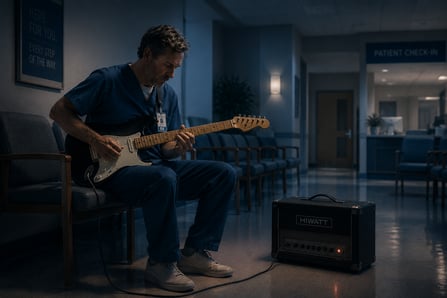 The closing guitar solo on Comfortably Numb — and I will go on record here as someone who believes it is the finest electric guitar solo ever recorded — was played by David Gilmour on a '55 Fender Stratocaster through a Hiwatt DR103. The Hiwatt is a British-made amplifier known for two things: extraordinary clean headroom and an almost brutal transparency. It does not flatter. It does not smooth. It takes exactly what you give it and puts it in the room at full fidelity. Through a Hiwatt, a great player sounds great. Through a Hiwatt, a mediocre player has nowhere to hide.
Now imagine Gilmour plays that same solo — same fingers, same Strat, same notes — through a cheap solid-state practice amp. The kind you find at the back of a Guitar Center on clearance. You don't get a slightly diminished version of one of rock history's defining moments. You get something unrecognizable. The talent is identical. The outcome is not, because the signal chain can't carry what the instrument is capable of.
|
|
"The instrument is not the problem. The signal chain is the problem. And in hospital contact centers, the signal chain has a name: it's the routing, the queues, the per-seat omnichannel licensing, and the $28-an-hour trained agent confirming that yes, the imaging center does open at 7am." — Jon Shelby, VP Healthcare & AI Enablement, Continuant Technology Solutions |
Here is something worth saying plainly: most hospital contact centers in 2026 are not failing at omnichannel. They have the platform. They bought Genesys or Five9 or NICE or Cisco and they paid handsomely for the capability to handle voice, chat, and SMS under one roof. Their agents are trained across all three channels. The omnichannel capability problem, for most facilities of any meaningful size, is largely solved.
The problem that isn't solved — and that doesn't get nearly enough attention — is the economics of what runs through that capability. Every interaction that touches a live agent costs roughly the same regardless of what the interaction requires. A patient calling to reschedule a cardiology appointment because their child is sick: that's a human interaction. A patient texting to confirm what time to arrive for their MRI: that is not. Both are landing on the same trained omnichannel agent, at the same per-seat licensing cost, eating the same finite capacity on a platform that charges by the channel and by the seat.
That's Gilmour through the practice amp. Not because the agents aren't excellent (trust me, they are), but because the signal chain is asking them to do things that have nothing to do with why you hired them.
The economics of omnichannel hospital contact centers break into three places, and the reason nobody has done the full calculation is that they live in three different budget lines.
The first is CCaaS licensing. Omnichannel capability on enterprise contact center platforms doesn't come cheap. The per-agent, per-channel model means that every seat handling voice, chat, and SMS carries a license cost that multiplies with volume. You're paying for the capability whether the agent is handling a complex prior authorization question or answering, 'do you accept my insurance.'
The second is staffing. Hiring a contact center agent who is genuinely proficient across voice, chat, and SMS is harder than hiring one who handles phones. Training takes longer. The skill set is narrower. And attrition in healthcare contact centers — already a persistent operational headache — is higher among agents who are being asked to toggle between channels all day for interactions that range from clinically complex to completely routine. The best omnichannel agents leave fastest, because they have the most options.
The third is the opportunity cost of what those agents aren't doing. Every minute a trained agent spends confirming an appointment time or telling a patient where to park is a minute not spent on a call that required their training. The contact center's capacity is finite and can’t afford a suboptimal distribution of what consumes it. Unlike the first two costs, this one is genuinely invisible. It shows up nowhere on the report because it represents interactions that were handled, just not by the right resource.
The good news is that this is a tractable problem with a straightforward frame.
Gilmour didn't play the entire album through a Hiwatt at full send. The amp earns its place in the signal chain for the moments that require it. The rhythm sections, the chord progressions, the parts of the song that build to the solo — those go through whatever serves them. The Hiwatt exists for the moment that needs it.
An AI agent handling patient interactions across voice, chat, and SMS — scheduling, reschedules, routine questions, after-hours volume — is the right amp for that part of the song. It doesn't require a per-seat CCaaS license for every interaction it resolves. It doesn't quit for a new job. It doesn't need to be hired or trained on three channels. And it doesn't consume the capacity of your best omnichannel agents on interactions that were never going to require them.
Your trained agents handle the interactions that need them. The complex prior authorization. The distressed patient who needs a human being. The escalation requires clinical context and judgment. That's the closing solo. That's what you built the signal chain for.
ConnectAI handles voice, chat, and SMS under a single platform, with a single integration to the EHR and real-time appointment write-back. It runs on Continuant Connect, managed end to end by Continuant — the same team that has been managing hospital communications infrastructure for thirty years. We are not the Hiwatt. We are what lets the Hiwatt do what it's built for.[C2]
The rest, as Gilmour would tell you, is just signal.
|
Frequently Asked Questions Can AI reduce hospital contact center costs without replacing the CCaaS platform? Yes. ConnectAI by Continuant works alongside existing CCaaS platforms rather than replacing them. AI handles the transactional volume — scheduling, reschedules, routine inquiries, after-hours interactions — that doesn't require a trained human agent, reducing the per-interaction cost and freeing agents for complex calls that need them. The CCaaS platform handles what it was built for. The economics of what runs through it change significantly. What is the average hospital contact center agent attrition rate? Healthcare contact center attrition rates average 30–45% annually, significantly higher than other industries. Agents handling omnichannel workloads — toggling between voice, chat, and SMS — show higher attrition than single-channel agents. The cost of replacing a trained omnichannel agent, including recruiting, onboarding, and lost productivity during ramp, typically exceeds six months of their fully-loaded compensation.[C3] How does ConnectAI handle voice, chat, and SMS in hospital environments? ConnectAI handles patient interactions across voice, chat, and SMS under a single platform with a single EHR integration. Confirmed appointments write back in real time via live FHIR API. Interactions requiring clinical judgment or human support are transferred to live agents with full conversational context — no repeat explanations, no cold handoffs. ConnectAI runs on the Continuant Connect platform, managed end to end by CTS. What does a hospital typically pay per contact center interaction? Gartner benchmarks put the median cost of assisted customer service channels at $13.50 per contact, compared with $1.84 for self-service. For hospital contact centers, that makes the goal clear: shift routine volume to AI while preserving trained agents for interactions that require human judgment. Once fully loaded labor, licensing, and overhead are counted, live-agent interactions typically cost several times more than interactions resolved through self-service or AI. Shifting routine, low-complexity volume to AI lowers the blended cost per interaction without changing headcount or the underlying CCaaS contract. |